How to get paid faster: invoicing habits for small businesses
Most slow payments start with fuzzy terms, late invoices, or a hard way to pay. A few steady habits fix all three.
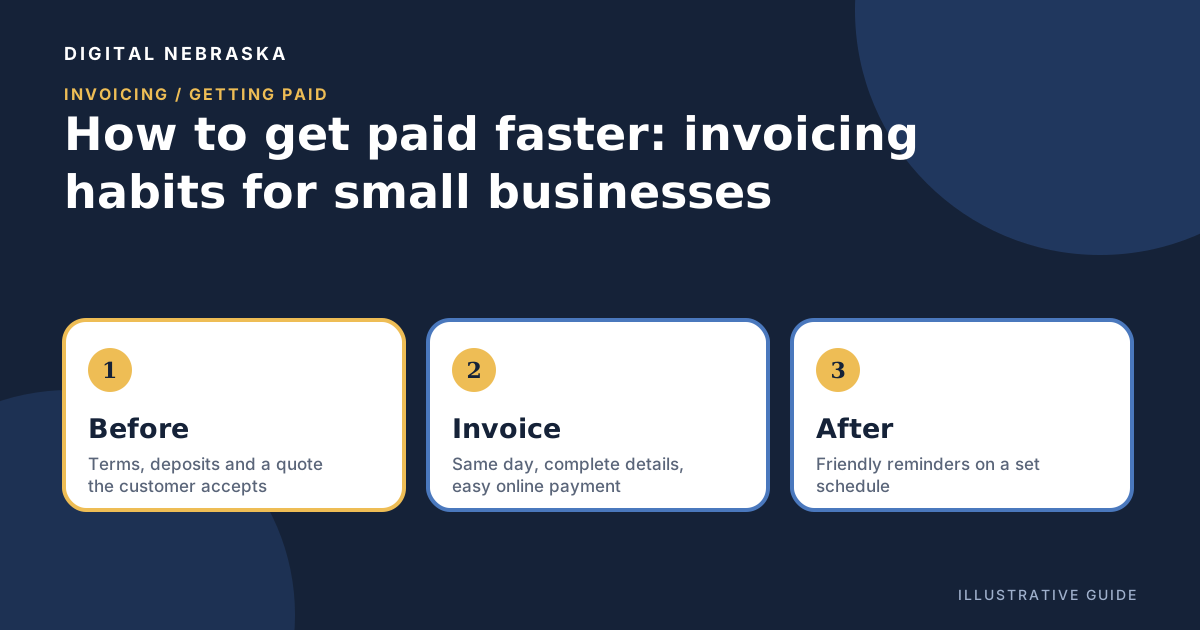
Doing good work is only half the job; getting paid for it is the other half. Slow payments usually aren't about bad customers. More often the terms were fuzzy, the invoice went out late, or paying took more effort than it should have. The habits below are simple, and most cost nothing but consistency. This is general information, not legal or tax advice; check with an attorney or tax professional for your situation.
Agree on terms before the work starts
The easiest invoice to collect is one the customer expected. Before you start, put the basics in writing, usually in your quote or estimate:
- What's included, and what would count as extra
- The price, or how it will be calculated
- When payment is due (on completion, on receipt, or a set number of days after the invoice)
- Which payment methods you accept
- Any deposit, and when it's due
Having the customer accept the quote, even with a quick online "approve," gives both of you the same starting point. If you plan to charge late fees, look into the rules where you do business before you add them to your terms.
Use deposits and payment plans for bigger jobs
For large projects or jobs that need materials ordered up front, a deposit keeps your cash from being tied up. Explain what it covers and how it's applied to the final bill. For customers who need time, a payment plan with set amounts and dates is usually better than an open-ended "pay when you can." Write down the schedule so nobody has to remember it.
Invoice promptly, with complete details
Send the invoice as soon as the work is done, ideally the same day, while the job is fresh in the customer's mind. A complete invoice heads off "what's this for?" delays:
- Your business name and contact information
- The customer's name and the job address, if it differs
- An invoice number and date
- A clear description of the work, with dates
- The amount due, the due date, and how to pay
Good invoices also help your bookkeeping. The IRS notes that "Good records will help you monitor the progress of your business" and that business transactions "generate supporting documents." Your invoices are some of those documents.
Make paying easy
Every extra step, from finding a checkbook to calling with a card number, is a reason to put it off. The SBA advises: "Accept forms of payments that are cost effective, secure, and provide a positive experience for your customers." A pay-online link on the invoice lets customers pay from their phone the moment they open it. The SBA also notes that with cards "You'll pay small processing fees for each credit or debit card transaction," so weigh that cost against faster payment for your own business.
Send friendly reminders on a consistent schedule
Reminders work best when they are polite, predictable, and the same for every customer. For example, imagine a schedule like this:
- A few days before the due date: a heads-up with the amount and a payment link.
- On the due date: a short "this is due today" note.
- A week or so after: a friendly check-in asking whether there's a question about the invoice.
- Two weeks or more after: a phone call from a person, not another email.
Keep the tone neutral. Many late payments are simple oversights, and a customer who feels respected is more likely to pay and to call you again. Set a regular time each week for someone to review what's outstanding. The SBA lists accounts receivable among the things to "Ensure that someone can manage."
Know when to escalate
If reminders and a phone call don't work, step up gradually: a written final notice with a clear date, an offer of a payment plan, and pausing new work until the account is current. Past that point you may consider a collection agency or court. In Nebraska, the Judicial Branch describes small claims as "a prompt and inexpensive way to resolve minor disputes" and notes that "Judgments in small claims court may not exceed $7,500." Other states have their own rules, and an attorney can help you weigh your options.
If an invoice truly can't be collected, talk to your tax professional. The IRS explains that "You may deduct business bad debts, in full or in part, only if the amount you were owed is included in your gross income in the current or prior year."
Digital Nebraska's invoicing add-on is built around these habits: quotes customers accept online, invoices with a pay-online link through your own Stripe or Square account, recurring invoices, and payment plans. It can send an optional reminder before the due date and automatic overdue reminders on the due date and at 7, 14, and 30 days past due on a fixed schedule, and an aging report shows who owes what.
Spending too many evenings chasing payments? Tell Digital Nebraska how you invoice today, and we'll talk through a steadier routine.