Texting customers: consent, STOP and the basics before you start
Customers like a quick, useful text from a business they trust; permission, an easy way out and carrier registration keep it that way.
Texting is how many people already talk to the folks they trust, so it makes sense that a local business would want to text customers too. A quick “We're on our way” or “Your appointment is tomorrow at 10” can save a phone call for both sides. The wireless industry group CTIA puts it this way in its Messaging Principles and Best Practices: “Messaging's popularity is largely attributable to its status as a trusted and convenient communications environment.”
That trust is exactly why business texting comes with rules and expectations. This guide walks through the basics before you send your first message. It is general information, not legal advice; for your specific situation, check with an attorney.
Get clear permission first
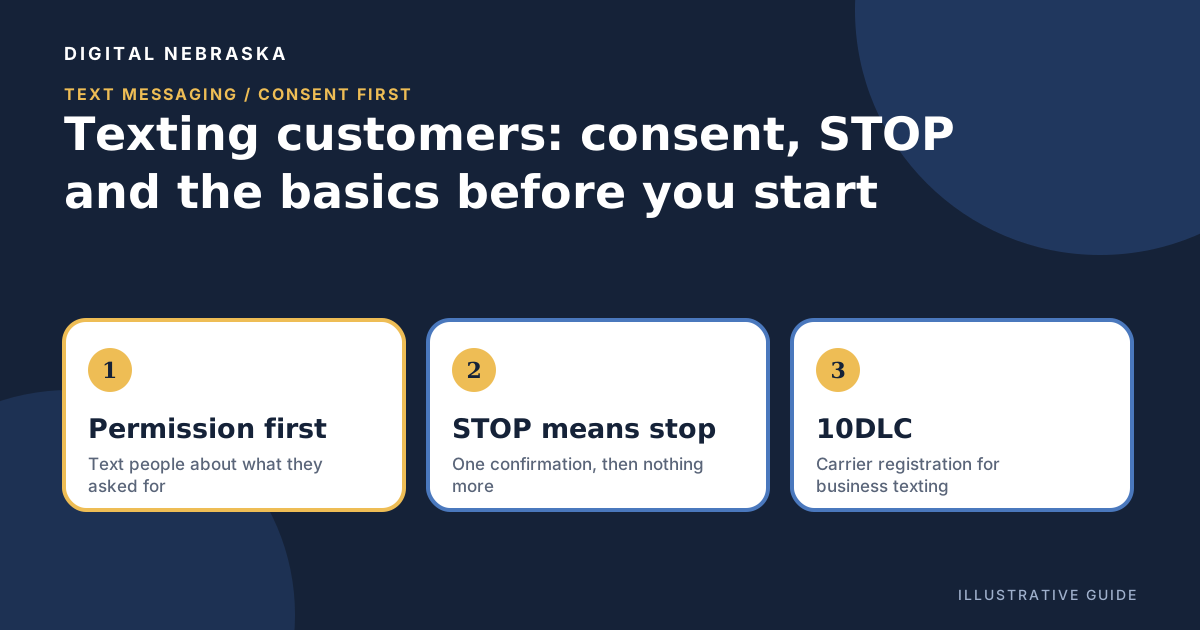
The simplest rule: text people who asked to hear from you, about what they asked for. CTIA's guidelines say businesses are expected to “Obtain a Consumer's consent to receive messages generally,” to “Obtain a Consumer's express written consent to specifically receive marketing messages,” and to “Ensure that Consumers have the ability to revoke consent.”
CTIA's guide sorts texts into three rough types:
- Conversational: the customer texts you first and you reply. If you simply respond, CTIA says no additional permission is expected.
- Informational: things like appointment reminders and alerts. The customer should agree to receive texts for that purpose when they give you their number.
- Promotional: sales or marketing messages. CTIA says the customer “should agree in writing to receive promotional texts,” and notes that adding something like a coupon code to an informational text may make it promotional.
CTIA also suggests keeping a record of consent, such as when it was given, how (a web form, a paper sign-up, a text keyword), and the phone number involved. And it says permission given for one purpose should apply only to that purpose. Someone who agreed to appointment reminders has not agreed to your monthly specials.
Federal rules from the FCC under the Telephone Consumer Protection Act also cover certain texts, especially marketing texts. The details depend on how messages are sent, which is one more reason to talk with an attorney before you start any promotional texting.
Honor STOP, every time
When a customer says stop, stop. The FCC's current rule at 47 CFR 64.1200 says a customer may revoke consent “by using any reasonable method,” and that replying with “stop,” “quit,” “end,” “revoke,” “opt out,” “cancel,” or “unsubscribe” counts. Other wording counts too if “a reasonable person would understand those words” as a request to stop. The rule says such requests “must be honored within a reasonable time not to exceed ten business days.”
The same rule allows a single confirmation text, as long as it “merely confirms” the request and contains no marketing. CTIA likewise recommends one final opt-out confirmation, then no further messages. Its guidelines also say businesses should read normal-language replies like “please opt me out” and act on them, and should not let capitalization or punctuation get in the way.
Say who you are and keep it relevant
A text from an unknown number that just says “Reminder: tomorrow” makes people nervous. Start with your business name. CTIA's guidelines say the sign-up invitation should make clear the type and purpose of the messages, the number they will come from, the identity of the business, how to opt out, and how to get help.
Then send only what fits what the customer signed up for. CTIA also warns against links that “conceal or obscure the Message Sender's identity,” so use links that clearly lead to your own site or booking page.
For example, imagine a salon reminder: “Main Street Salon: see you Thu at 2 pm. Need to change it? Use the link in your booking email. Reply STOP to opt out.” It names the business, serves the customer, and shows the way out.
What carrier registration (10DLC) means
Business texting from a regular 10-digit phone number in the US runs through a registration system called 10DLC, short for 10-digit long code. The Campaign Registry, which runs that registration, describes 10DLC as a channel in which businesses and their texting providers “are verified prior to being allowed to send messages.” It says it works with mobile operators to register business texting campaigns, offering “transparency into messaging origins and content.”
In plain terms: your texting provider registers your business (the “brand”) and the kind of messages you will send (the “campaign”). The registry describes itself as the hub where providers “register their customers' brands, along with the campaigns linked to those brands,” so this usually happens through your provider rather than on your own. Plan for it before your launch date, and be ready to describe your messages and how customers opt in.
Mind the clock
Nobody likes a promotional text at 6 a.m. The FCC's rule says no one may make a telephone solicitation to a residential subscriber “before the hour of 8 a.m. or after 9 p.m. (local time at the called party's location),” and it says those rules apply to telemarketing texts to wireless numbers to the extent described in an FCC order. Keeping marketing texts inside those hours, in the customer's time zone, is a cautious habit. Ask your attorney how the time rules apply to your messages.
Getting set up the right way
Digital Nebraska's text messaging is built for one-to-one customer conversations, not mass text blasts. It includes a shared two-way inbox, text reminders and sequence steps, automatic STOP, HELP and START handling, opt-out blocking, and a record of each customer's consent date and source. It requires a business texting account and US carrier registration. Pair it with online booking to send text reminders, alongside email reminders, with self-service reschedule and cancel links.
Thinking about texting your customers? Tell Digital Nebraska what you'd like to send and who it's for.