What should a small business improve first for local search?
Start with the customer question your current site fails to answer, then choose the smallest useful fix.
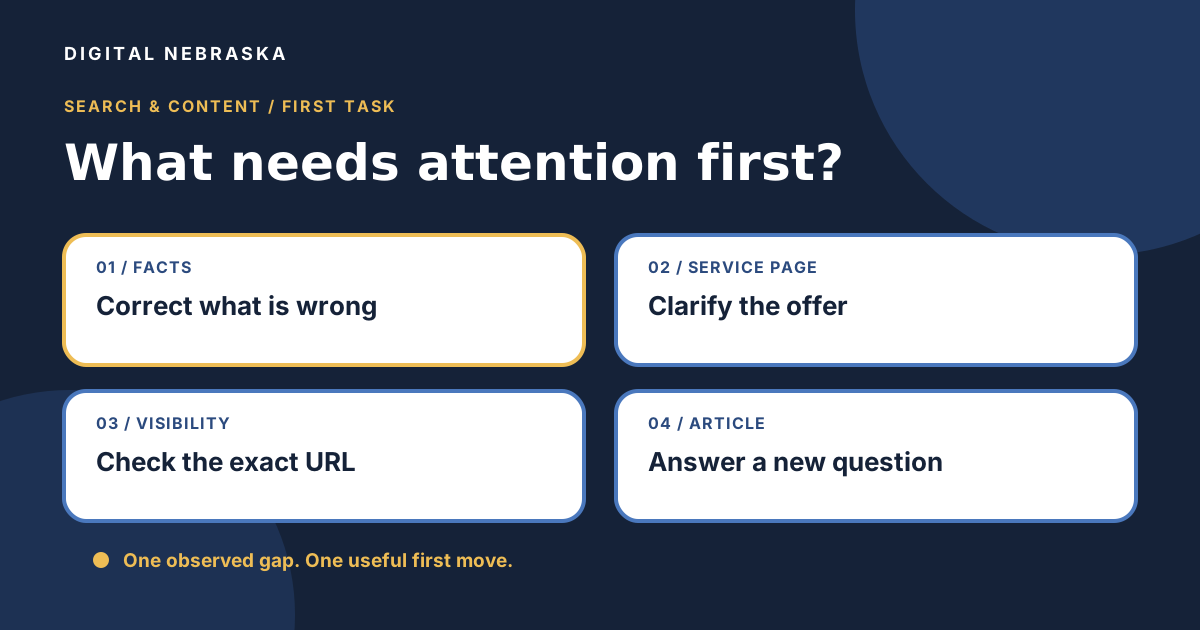
If your business already has a website, the next step is not automatically another blog post. First ask what a customer still cannot learn or do. Wrong hours deserve a correction. A hard-to-understand service may need a clearer page. A useful page that seems absent from search deserves investigation. A recurring question no page answers may deserve an article.
Digital Nebraska discusses local SEO, AI-search readiness, and article writing as separately scoped work. This guide helps you bring a concrete first question to that conversation; it does not promise search placement.
Begin with a question a customer actually asks
Write down the question in the customer's words. Which current page should answer it? Can someone find the answer there, tell whether it is current, and see a sensible next step? “We need more SEO” is too broad to choose work. “Our service page does not explain which jobs we take” identifies a page and a problem.
Try this: Ask someone unfamiliar with the business to find your main service, current hours, and contact route on a phone. Note what they cannot find without you explaining it.
Choose among four first tasks
1. Correct business facts
If your name, hours, contact details, or service-area wording are wrong on a page you control, fix those facts first. If you manage an eligible business profile, check its details too. Ask who owns the current information before editing it; a new article cannot repair an inaccurate address or phone number.
2. Improve an existing service page
If visitors reach a page but still cannot tell what you offer, who it fits, or how to contact you, strengthen that page. Give the service a plain-language description, explain the important boundary, and make the next step easy to find. If one page carries too many distinct services, use the one-page fit guide to frame whether a broader architecture is needed.
3. Investigate a visibility question
If the right page exists but you are unsure whether search can find it, check the exact URL and information available in your own Search Console account before commissioning more copy. An indexing or internal-link problem calls for a different task than a missing answer. Do not mistake a single search you performed for a full diagnosis.
4. Write a distinct article
An article earns its place when customers repeatedly ask a deeper question that your existing service page cannot answer well. Compare the idea with the two closest pages you already have. If one already answers it, improve that page. If the question is genuinely different, ask someone who knows the work to supply facts and review the final explanation.
A five-minute first-task worksheet
Bring these answers to a planning conversation. A blank is a question to investigate, not a fact to guess:
- Customer decision: What is the visitor trying to decide?
- Current answer: Which URL should answer that question today?
- Observed gap: What is missing, wrong, hard to find, or hard to understand?
- Fact owner: Who can verify the business details or example?
- First move: Is this a correction, page improvement, visibility check, or new article?
Illustrative example: a shop's service page explains its repair work, but customers repeatedly ask what to prepare before a visit. If that page cannot answer the question clearly without becoming unwieldy, a focused preparation guide might help. This is not a Digital Nebraska customer or a claimed search result.
Take the smallest useful step
If the current site does not yet explain the business clearly, Website Launch may be a separate starting point. Its defined one-page scope does not include ongoing SEO or custom article writing. If your site is in place, explore separately scoped search and content support and tell us what customers still need to find out. Deliverables, review steps, timing, and price are agreed in a separate proposal.